The DAS Chronicle is our history-within-history, recording the actions and intrigues of our members within the historical setting of the Anglo-Saxon Chronicles.
The last digit of the current year provides the year we’re following in the 870s from the Anglo-Saxon Chronicle, so the story of 2016 will be set within the events of 876 (which actually spans 875 to 876 A.D.)
Note that the 21st century location of a DAS event doesn’t have to match the geographical setting of the 9th century story. Organisers are free to set their event anywhere that makes sense for the plot.
Historical Background
The Vikings raided the English kingdoms throughout the 9th century, but these were small raids and the Vikings always returned home over winter. Things changed in 866, the year when Aethelred became king of Wessex and the Great Heathen Army, led by the sons of the semi-legendary Ragnar Lodbrok (Ivar the Boneless, Halfdan, and Ubbe), attacked Britain and didn’t leave, overwintering here. They descended like locusts, stripping an area bare and then moving on.
In 867 the Great Army went to Northumbria, which was ravaged by civil war between the king Osbriht and the usurper Aelle. The Northumbrians united against the Vikings, but both ‘kings’ were killed in battle at York, and the Vikings make Ecgberht the new king of Northumbria. In 868 the Great Army moved on to Nottingham in Mercia, and King Burhred of Mercia got aid from his brothers-in-law Aethelred and Alfred of Wessex to support him in besieging the town- but the siege was a stalemate, and eventually peace was made. In 869 the Vikings again took Northumbria, then in 870 they came down through Mercia to take East Anglia. In East Anglia they killed King Edmund in battle at Thetford, ravaged the land, and sacked the abbey at Medhamsted (Peterborough) “burning and breaking, and slaying abbot and monks, and all that they there found”.
In 871 the Great Army moved into Wessex for the first time. They initially took Reading, but then King Aethelred of Wessex and his brother Alfred arrived and a bloody series of nine battles erupted. King Bagsecg was slain at the Battle of Ashdown, King Aethelred passed way of natural causes, Alfred become the new King of Wessex, the Great Army was reinforced by the Great Summer Host led by Guthrum, and finally the two sides made peace…
The DAS Chronicle
In 872 the Vikings fell on London, and forced the Mercians to make peace. Read about our Sack of London event here.
In 873 the Vikings went north against the Northumbrians again, and overwintered at Torksey in Lindsey, again with the Mercians making peace.
In 874 the Vikings fell on Mercia. King Burhred was exiled, and Thegn Ceolwulf took his place. Read an overview of our year (and what history says happened) here.
Our first event of 874/2014 was The Kingslayer, at which a small group of Vikings raided a monastery on the edge of Wessex, and stole the Kingslayer (the sword that killed the Viking King Bagsecg in one of the few battles where Englisc beat the Vikings), to weaken Mercian resolve and enable a prophecy. You can read about it here.
Our second event of 874/2014 was To Curse a King, at which the Vikings used the magic of the Kingslayer to erect a potent nithing-pole inside Burhred’s favourite hunting ground, giving him another blow to his morale and unleashing powerful spirits against him. You can read about it here.
Our third event of 874/2014 was Before the Battle, at which the Vikings and Englisc both prepared for the battle to seal the fate of Mercia, and an introspective Viking leader, Ivar the Boneless, asked the assembled forces exactly what they wanted. You can read about it here.
Our fourth event of 874/2014 was The Doom of Burhred, at which the Vikings and Englisc fought a terrible battle, King Burhred of Mercia fled, the Vikings declared Ceolwulf King of Mercia, and the Heathen Host fractured as King Ivar died and they were torn apart by arguments.
Our final event was set shortly after, as the world was still reeling from the death of Ivar and flight of Burhred. Our warbands turned against each other, in a vicious skirmish through the woods of Mercia.
In 875 the Viking forces split, with Halfdan marching north to fight the local Englisc, Picts, and even invaders from Norway; whilst Guthrum marched to East Anglia to subdue the Englisc there. Read about our initial plans for the year and what history says happened here.
Our first event of 875/2015 was The Hunt For Ivar’s Treasure, at which the leaderless Vikings attempted to recover gold that Ivar hid after looting Medhampstead Abbey 5 years ago (and the Englisc tried to stop them!) At the banquet, the Vikings received news from their (possible) kings, and faced some tough choices…
Our second fighting event of 875/2015 was Shipwrecked! To quote the A-S Chronicle: “This summer King Alfred went out to sea with an armed fleet, and fought with seven ship-rovers, one of whom he took, and dispersed the others.”
Our final event of 875/2015 was Looting the Looters, where the Englisc ambushed the shipwrecked Vikings as they attempted to get back to East Anglia, and much treasure changed hands.
876 was a year of consolidation and establishment of power blocs – you can read our initial plans here. King Harald Finehair of Norway sought to gain control of the Isles and Northumbria – but was driven out of Northumbria at least by Vikings united under Halfdan Ragnarsson, with the Westmen seizing the Raven Banner of Finehair’s forces. Halfdan said the Vikings should secure the north before pushing to take Wessex; but Guthrum said they should take Wessex whilst they had momentum. The Oestvikinga and Holmbyggjar followed Guthrum to war, whilst the Westmen followed Halfdan north – where they got caught up in some very complex politics and all sorts of treacheries between Britons, Scots, and Picts. Meanwhile, the Cilternsaete fled Ceolwulf’s Mercia and took refuge in Wessex, where they aided Anir Thane’s Sumorsaete in defending Alfred’s borders. Guthrum’s forces took Wareham but were trapped there – and the Saxons took Vikings as hostages in exchange for peace.
877 was a year of broken oaths and broken forces, you can read our initial plans here. It began as the hostages broke free, and fled with the rest of Guthrum’s forces across Wessex, seeking to join up with a naval force sent to Exeter… But the naval force was destroyed, and the Englisc scattered the fractured Vikings.
In 878 news came of the deaths of the last two Ragnarssons, Ubbe and Halfdan. Guthrum unified the Viking forces, proudly bearing at least one Raven Banner, and pressed Wessex hard. But the Englisc managed to get word from Alfred, who was sheltering in a swamp, and rose up in great fury. Guthrum was defeated, forced to be baptised and become Athelstan. The whole of what is today England was divided into Danelaw and Wessex.
And so, in 879, a great peace fell upon the land. There were occasional border disputes, and trouble makers sometimes sought to re-ignite old wars (although Hauk of the Oestvikingae’s attempt to steal a Saxon Thegn’s helmet to stir up trouble came to naught), but the two forces had time to rebuild and settle.
But no peace lasts forever, and we’re now entering the 880s. Of course, the pandemic has slightly disrupted our plans! But luckily 880 and 881 are both fairly quiet, in England at least: A.D. 880. This year went the army from Cirencester into East-Anglia, where they settled, and divided the land. The same year went the army over sea, that before sat at Fulham, to Ghent in Frankland, and sat there a year. A.D. 881. This year went the army higher up into Frankland, and the Franks fought with them; and there was the army horsed after the battle.
As we haven’t had any fighting events for a while, and it might be a while before we get any, it is worth thinking what your character is up to in this time!
Vikings, are you settling and dividing the land of East Anglia (this is probably the time that the Holmbyggjar get settled into Osea Island)? Or are you heading up to Northumbria or the Isles, and looking after lands there (off to Canna, or Mann)? Or are you off pillaging France?
For the Saxons, this is probably the time that Alfred really builds up the network of fortified burhs to defend his borders, the Burghal Hidage. They were possibly started in the late 870s, but this was a chance to turn them into permanent and significant fortifications. It was also quite possibly a time he built up his own fleet of ships – 882 features a Wessex naval victory against the Vikings. How might your characters fit into this time of preparation, what are they doing to help Alfred?
One big storyline that we’re keen to play through once we’re all back together is the fate of Mercia. It is in the late 870s or early 880s that Viking-appeasing King Ceolwulf of Mercia is replaced by Æthelred of Mercia – although Wessex always regards Æthelred as an ealdorman under Alfred, not a king in his own right (and Æthelred only holds West Mercia, as the Vikings keep control of the East). One of Æthelred’s first actions (possibly once he is in charge, or possibly under Ceolwulf) is an invasion of Wales, but he is roundly beaten at the Battle of Conwy in 881. Hauk and Herewulf both have plans for events that could be themed around this storyline and the shifting sands in Mercia, which they’d hoped to run this year but look forward to running when we can.
Looking further forward, the 880s are also characterised by Alfred going on the attack: fighting in London, Rochester, Stourmouth… Plus treachery from the Vikings in East Anglia, and no doubt plenty of border skirmishes! But there are fewer large sweeping changes in political leaders, so it should be a good time to focus more on our personal stories and rivalries and less on “wait, who is king now?”
Latest Chapter
- The Sandford Mystery
In the late spring of 885, strange events occurred in and around the village of Sandford, a little to the south of the Oxnaford.
As told by Father Beorhtræd
Fr Beorhtræd to the Lord Bishop, Greeting. Grace, peace and mercy from God our Father to you, my Lord Bishop. It has been just a few days since you have sent me to observe the condition of the Christian faith in that land beyond the sea, Hibernia, however, strange events near the centre part of this land, West of the Thames, such as needs reporting to you and our Lord King. I have reached the land of Gwent, and the good people here have sustained me for a night.
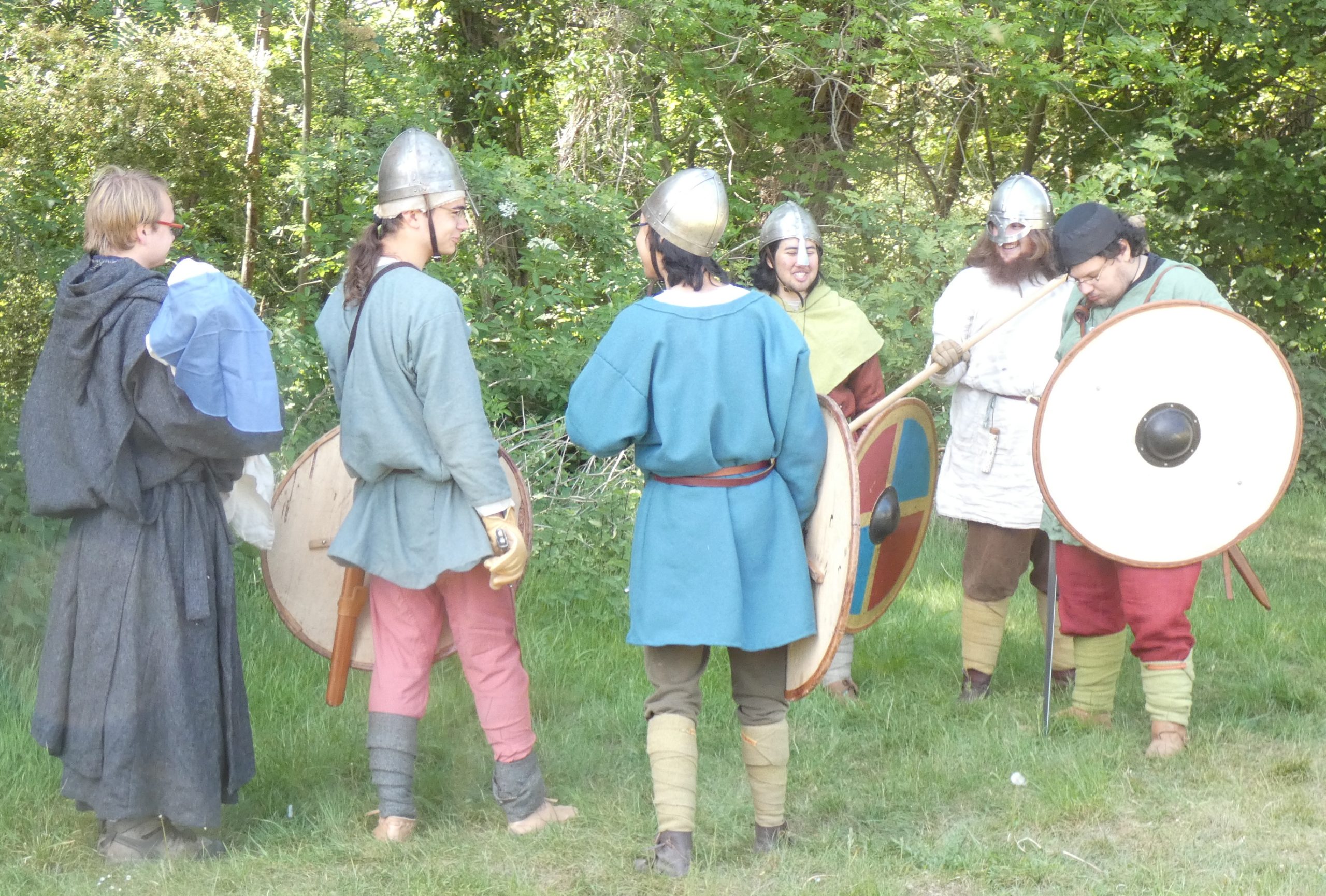
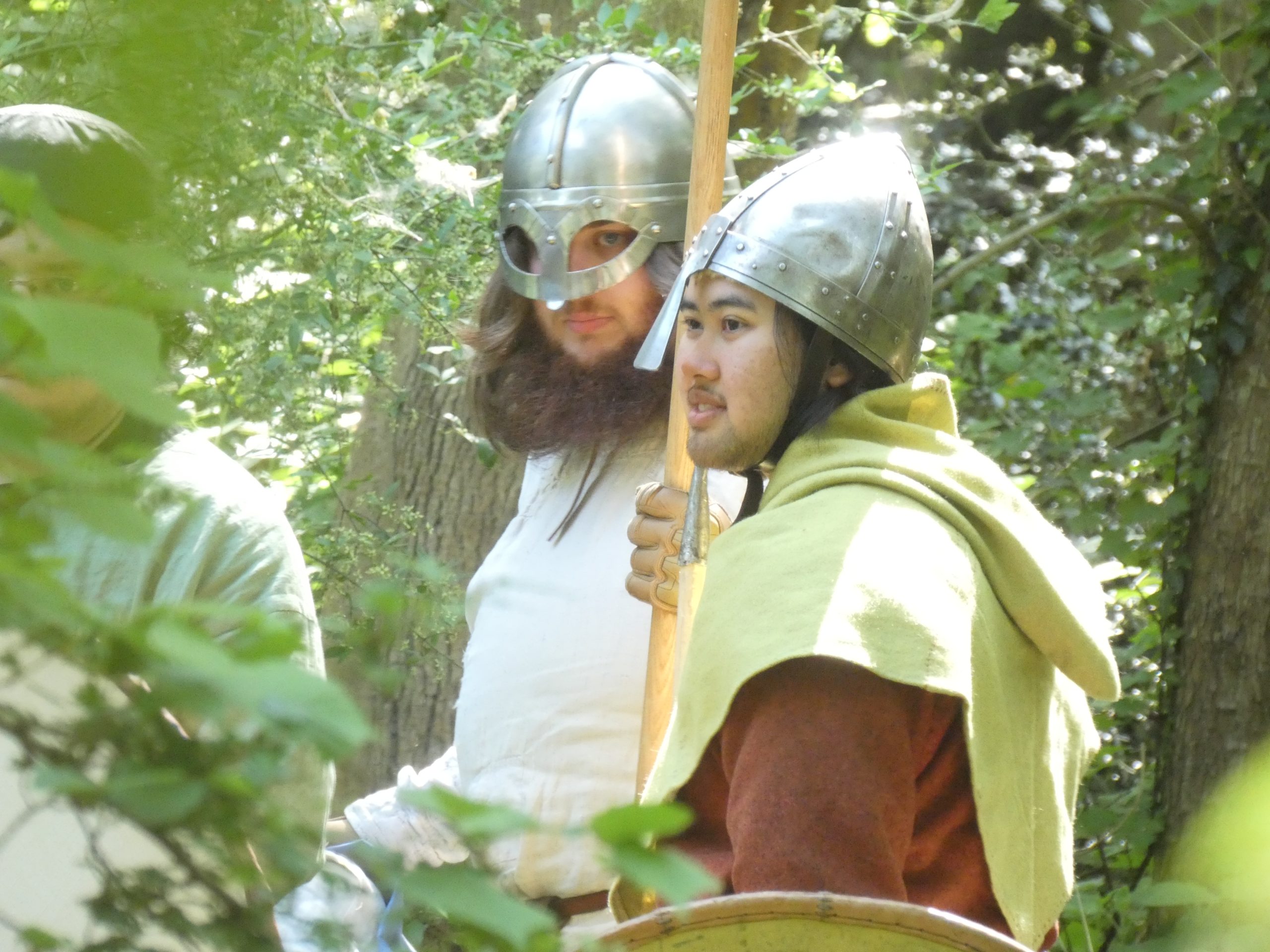
I was walking through a wooded area when my path coincided with a nun of a nearby monastery and a Christian healing woman, having traveled to England from her native Norway. We traveled along for a short while until we happened upon a group of men-at-arms arguing over something or another. It became clear from their attire these were a group of Norwegians and Saxons, if not of our same king, at least of our same blood. These Norwegians clearly consisted of two pagans, but included a Christian, albeit of questionable religiosity. I tried to pass around the back of the Norwegians, but they had heard me. By this point, I was no longer with the nun and the laywoman. I was caught at spear-point by the Norwegians, wanting to ransom me back to the diocese, but the argument between the Christian Saxons and the Norwegians was such that I could slowly walk to be guarded by the Saxons.
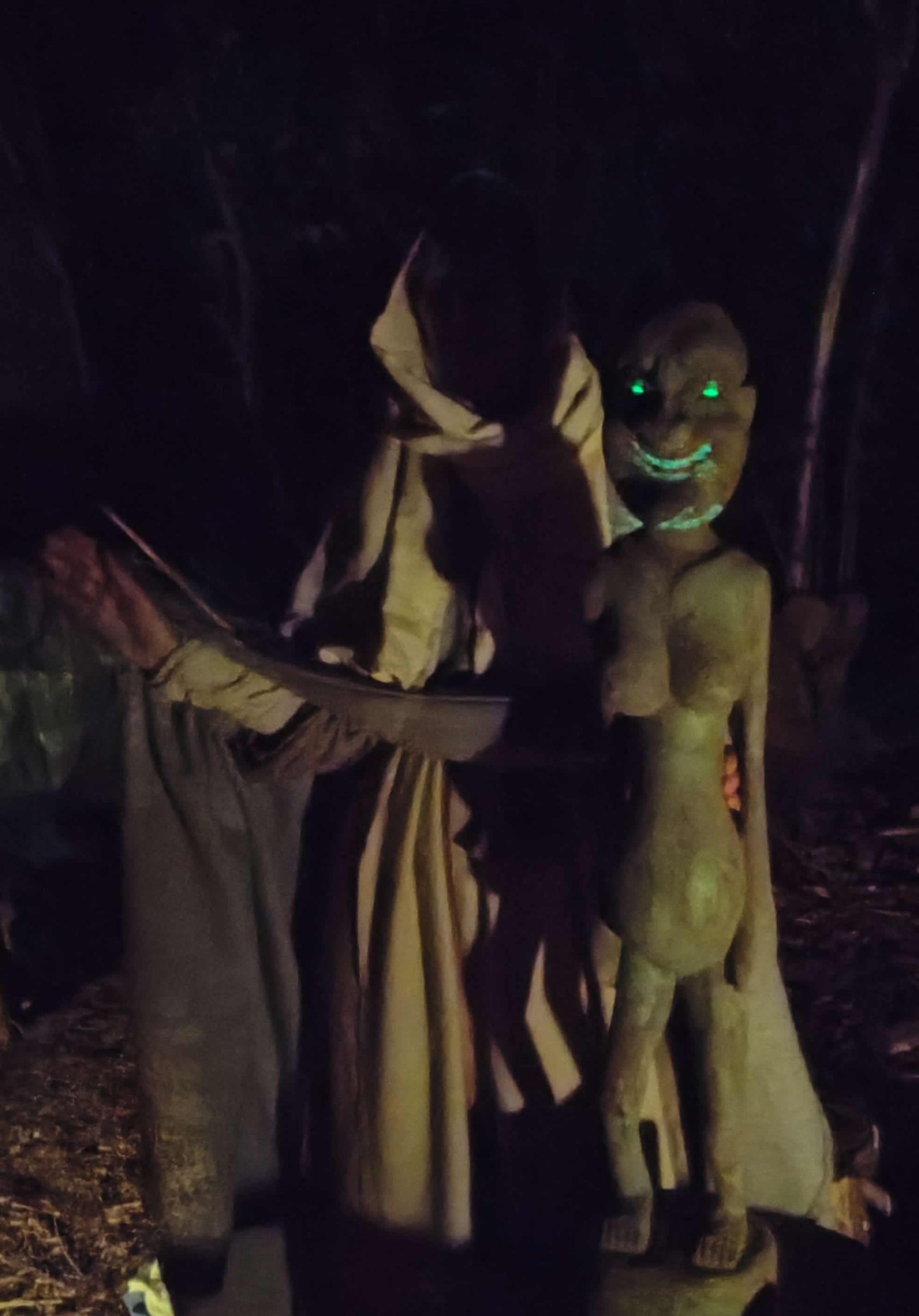
Afraid fighting would ensue, I left the two parties, again accompanied by the laywoman (both her and the nun appeared again), where we happened upon a small clearing with a relic of Our Lady left out in the open. It was such an odd spot to leave such a relic, I thought at first I beheld a way-flag for other wayfarers. After praying a Hail Mary, I was at a bit of a loss for what to do. Hearing the combatants walking up, I picked up the relic to escape, and had decided that I should bring it with me to Ireland to aid me in evangelising the Irish. I am not sure what happened to the laywoman at this point.
I made it a fair distance, but one of the Norwegians, the ‘Christian’ caught up with me and tried to convince me to hand over the relic in exchange for safety. It was clear his group was demanding the relic because they wanted to exchange it for coin. They did not even know about it, but only decided to take it when they saw me with it!
The next events are a bit hazy for cause of severe loss of blood. The pagans caught up with us closely trailed by the Saxons, who were themselves accompanied by the nun and laywoman. There was another fellow who had been around as well, constantly pointing this strange cylindrical object around the area. I believe I overheard he worked silver. As the Saxon warriors caught up, one of the pagans, clearly richer than the others, sliced me with his sword near my left shoulder. I dropped the relic, and shortly fighting ensued. I myself could not flee, but, as the fighting moved up a hill I could assist in the healing of the Saxons. This silversmith, if he can be found, may not truly hold the Christian religion, as he helped the pagans. Unfortunately, the relic was gone by this point.After heading up the hill with the nun and laywoman, we ventured upon a camp, wherein one of the pagans was sat in a tent with the relic speaking with a Saxon trying to negotiate to buy the relic. Another Saxon was on the ground being robbed by the other pagan and the Christian. Seeing Christians robbing Christians is bad enough, but being that this robbery was for the benefit of pagans, I saw no choice but to perform the rite of excommunication, in the hope that if any Christian faith did remain, it would eventually win out over evil tendency. I may be right as well: the nun saw fit to remove his jewelry, a presentation of the Holy Cross, and he was so stunned that he let the nun take it. If he is found in repentance, I would be glad to hear of the lifting of this excommunication.
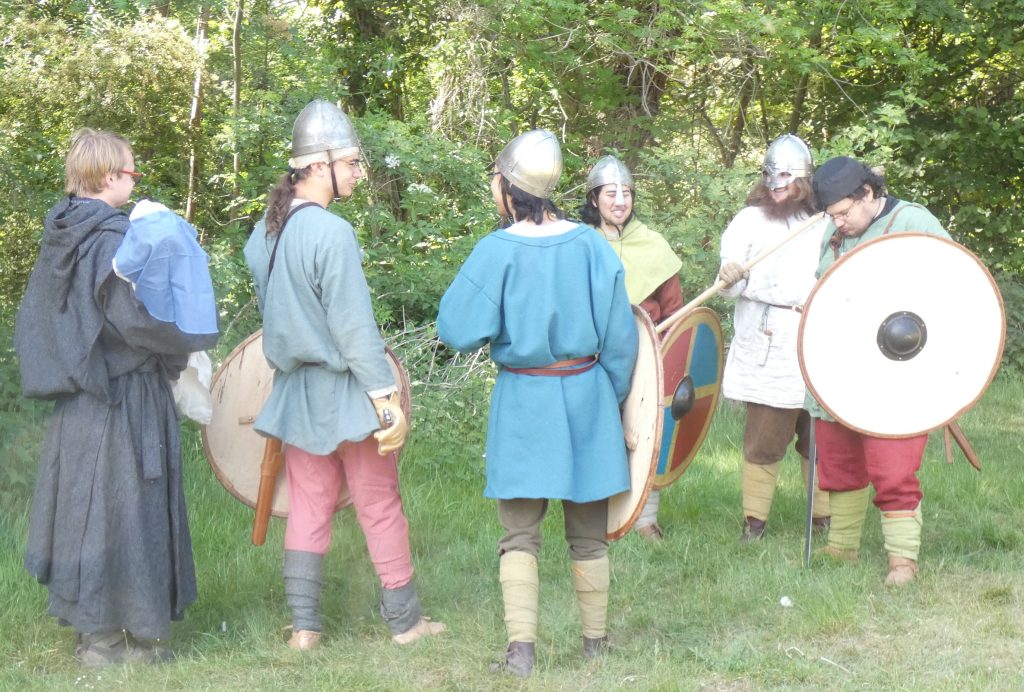
Before I left, I heard conversation about business dealing regarding sheep herding, and this was between one of the Christians and, I recall, a pagan! Perhaps the Saxons, too, do not all have as pure holy intention as I thought. The nun was insistent that the relic is regarded as holy by the locals, despite them being happy to leave it unprotected and in the open, so I returned to my journey as you, my lord bishop, had directed to me.
On the River Severn
Among the Silures of GwentAs told by Halfdan “the Pompous” Friðgeirson
Reuniting with my foster brother and his lot has, thus far, proven an interesting endeavour. Hjalmar remains himself as ever of course, but Hauk’s once fearsome crew has rather fallen.
Currently the other travelling companion is a fellow named Signi. Signi Signison, at that, as though the forename were not odd enough alone. He is a strange man who has changed between being Christian and being Correct some 3 times this week, though he’s a good enough laugh when in the cups, and decent for a scrap.
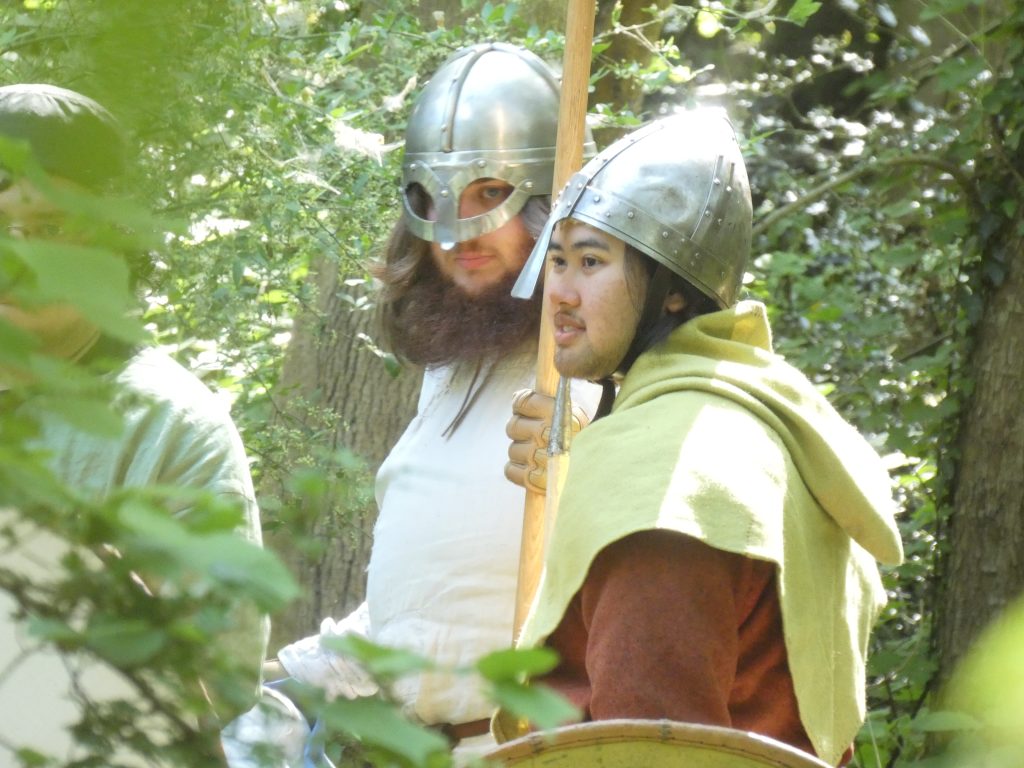
Still, it is with this odd company, and the silversmith Alf on a trade venture, that I found myself wandering the woods of the area the Saxons call “Oxnaford” or some such. Some of said locals have gone missing of late, and far be it from me to turn down free land. Not to keep, mind you, ti’s a place of floods and winds, but a tidy profit could be made in selling it on. Not to mention rumours that some of the locals were some of those monks the Saxons seem so fond of, and fond of giving all their treasures to, and apparently one such treasure could still be found in these woods.
Now it is worth noting, a lot of the things Christians call treasures are actually bits of wood or dead people. I don’t know why they’re so important, but I’ve seen a monk or two in my day lay down his life trying to get some tiny silk lined box of finger bones to safety. I chucked the bones in the river and took the silk, only to later learn, to my great sorrow, the sort of prices these lot will pay for their special dead people bits. Probably a good scam to be had in that, but that’s neither here nor there at the moment. Regardless, while gold or silver would be preferable, I was at the very least hopeful that whatever this treasure was could be ransomed.So it was that we was walking through the woods of this now emptied land, that Signi got himself into a tangle of some caterpillar silk, hanging all about every bloody tree in the forest, or so it seemed. But our pause to sort out this mess was what led to our hearing of another group coming through the forest. We beheld a monk!
Obviously my first instinct was to threaten him with violence for money. But apparently he had no money at that time, and was not local enough to quickly ransom, so, cunningly, I let the monk go, for I knew a fact of natural and mystickal philosophy; Monks smell relics and are attracted to them. By letting him go, we could follow him, surreptitious-like, through the woods and be sure to find our relic.
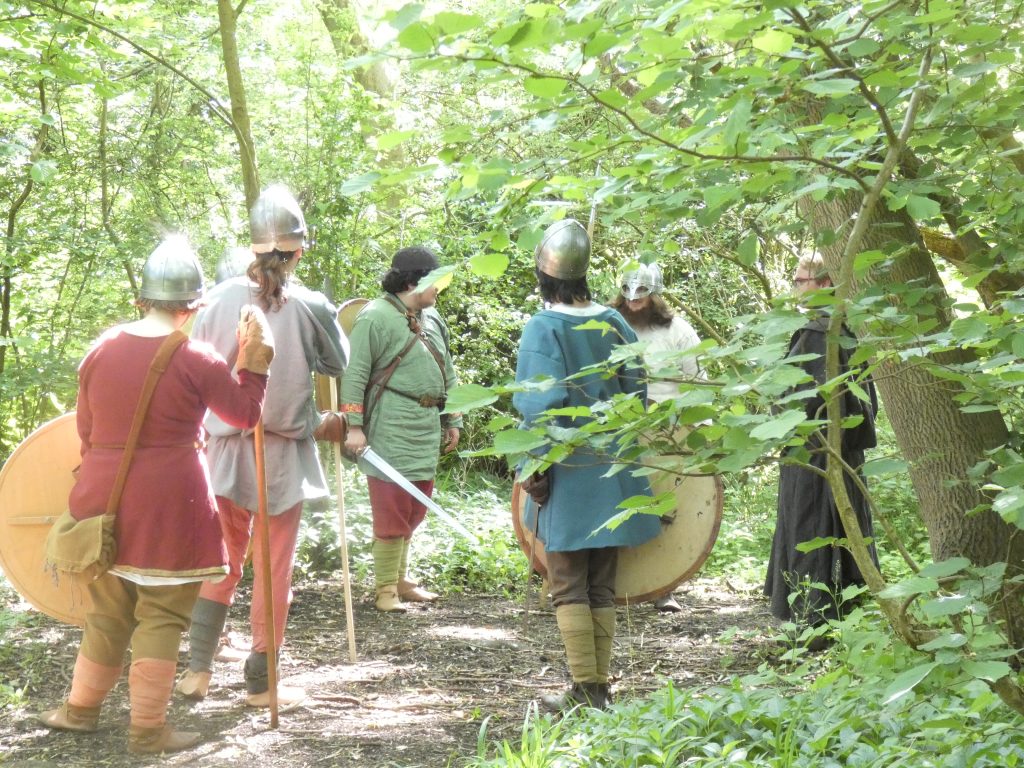
Unfortunately our quest was interrupted, by some trader, mercenaries, and a nun. Apparently on the lookout for the relic also, and the trader, named Leofdag, looking to establish sheep pastures for farming wool locally. Well one minute we discussed a trade deal with Leofdag, to guard his sheep, next minute we were battling the bastards for rights to ransom the nun and have her lead us to the relic. Everyone ended up injured and a passing healer, norse girl though she spoke in the prayers of the Christians, helped us up, so we dispersed.
But once more we had the whiff of monk, this time sighted with relic in hand! Signi gave a meandering chase, in which we once again did battle with the Christian mercenaries, apparently now out to defend the relic, but Hjalmar and I incapacitated the fools while Signi cornered the monk. Signi was trying his best to Christ him up into giving us the relic, but this was failing, and we heard the Saxons coming.
It is at this juncture that I want to address and clarify some persistent rumours I’ve heard floating around. No, I didn’t “Stab a defenceless monk”. The monk is fine. I barely glanced him with my knife! Gave him one of them stigmata his lot find so fashionable. He was fine. Honestly. Totally fine. But, relic in hand and monk in tow, we faced the Saxons.
Leofdag came to offer diplomacy and peace. Apparently the nun and such would be willing to discuss terms with us back at their encampment. Unfortunately the Saxons got apparently offended by the sight of an “injured” monk (barely a cut!) and so commotion ensued once more, in the midst of which the nun grabbed the relic and made off! Hjalmar have pursuit and snatched it back at their camp, while Signi faced some kind of ritual from the monk, and proceeded to get robbed by a nun. A viking, a drengr, a fearsome man of the north despite his name, robbed of his jewellery by a nun. Such shame can never be lived down.As told by Sister Mildþrȳð, nun at St Frithuswith’s monastery, by the Oxnaford
Well! What a day that was, sister! As you know I travelled south at our abbess’s command to find out why the priest of Sandford has not responded to her last message. I took company with the wool merchant Leofdag, thinking he would be enough protection in these well defended lands of Wessex and so close to Oxnaford. How wrong I was! Anyway, when we reached the village indeed there was no sign at all of the villagers, and the church was deserted and the priest nowhere to be seen. As there seemed nothing to be done about that, I decided the best thing was to try to find the Sandford church’s famous statue of the dear Virgin Mary which as you will know they unveil for special feast days. As the feast of Saint Potentiana was only two days away I knew that this blessed relic must be found if possible!
Leofdag and I put our trust in the Lord and ventured through miles of trackless forest in search of the statue. Bugs and wild beasts attacked us but we were not daunted, let me tell you! And eventually we found that there were all manner of strange people in the area, mostly up to no good I am sure, including a priest who actually stole the Virgin’s statue from the church and seemed terribly keen to take it to Ireland of all places, I don’t see why the Irish would have any right to a Wessex relic. Anyway, I was actually threatened by a group of Danes who thought that any holy relic must be worth money to them – this despite one of them having the actual cheek to wear a cross and (as I later found out) pretend to be a devout Christian! Now that was earlier, of course, and later on I found they had taken the statue from Father Beorhtræd but I managed to pick it up while they were arguing about something else and I hitched up my habit and ran off with it! That’s when the Vikings chased after me which would have scared me half to death but as I say Aldhelm protected me in return for a silver brooch that I had brought in case of some emergency and I found my way back to the village where Leofdag’s mother had set up camp. I have to say that I think Dagrun may actually be the brains of their venture. But oh! I took my eye off the statue and the Danes sneakily stole her away again! Let me see, was it before or after that when I confronted that Dane with the cross and I took it from him because he proved himself to be no friend to the church and utterly untrustworthy. Did I tell you he actually stabbed Father Beorhtræd? I am sure he would have died on the spot had there not been a healer woman present, Sigrun (not sure about the name but something like that?), who though in fact a Dane is of the true faith and I’m sure that’s why she is blessed with such medical knowledge. Or was it that strange travelling silversmith who healed her. Goodness me there were a lot of strange people in the area that day and it was terribly confusing even to me and you know how clear my understanding always is.
At one point a mercenary fighter of terrifying aspect, named Aldhelm, turned out in fact to be a stout fellow and he aided me in recovering the statue, though I later lost it like I already told you. Do try to keep up.
Well it all turned out for the best of course, as we are protected by St Frithuswith AND the Virgin Mary. I exchanged the perfidious Dane’s silver cross for the statue and Loefdag had finally caught up with me so all was well. Now I think about it, maybe somebody stole her again but I kept my wits about me and was able to rectify the situation.
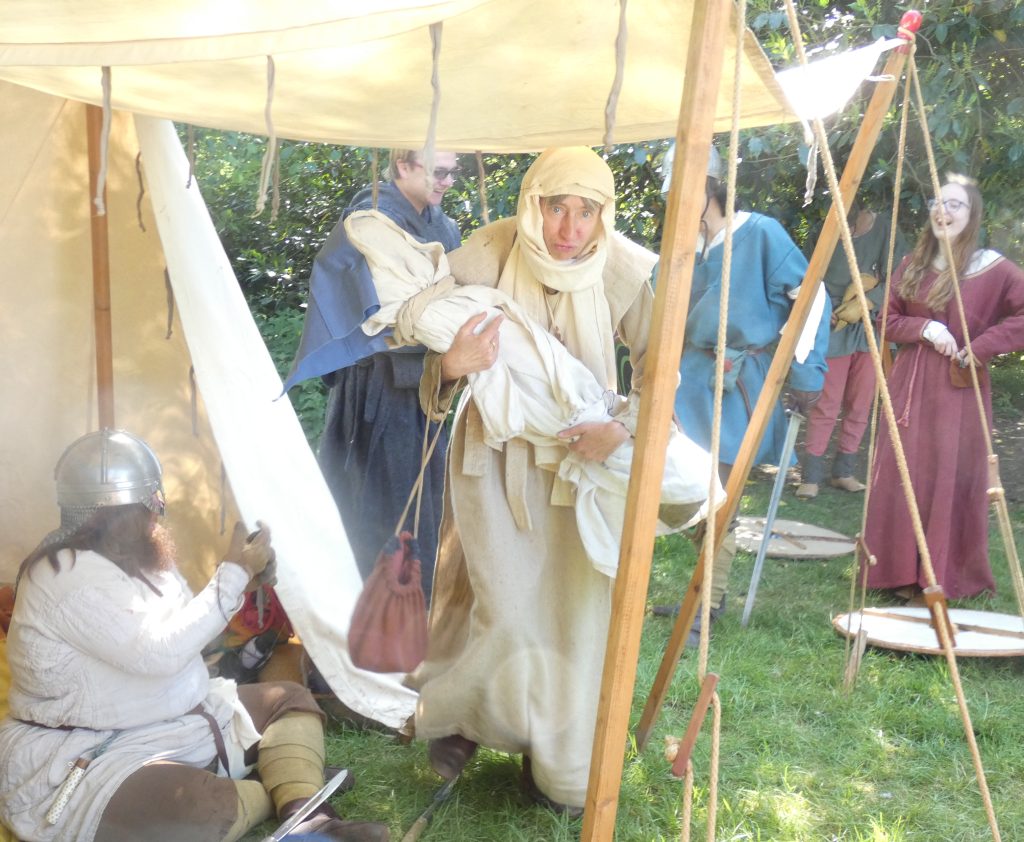
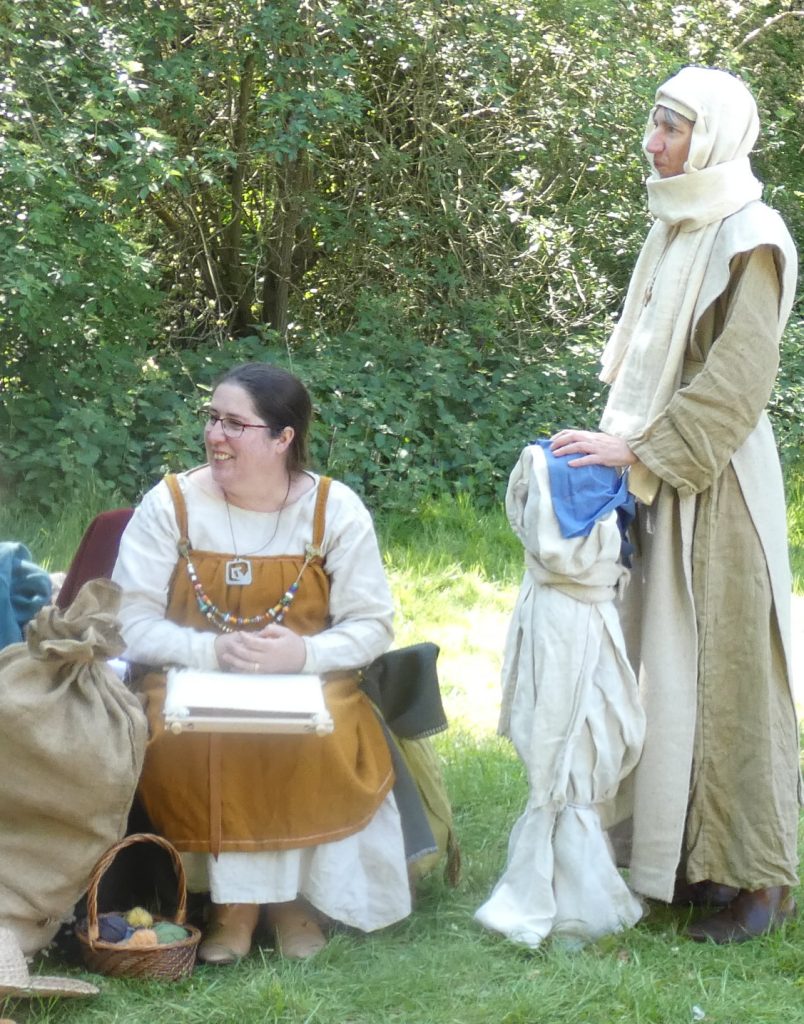
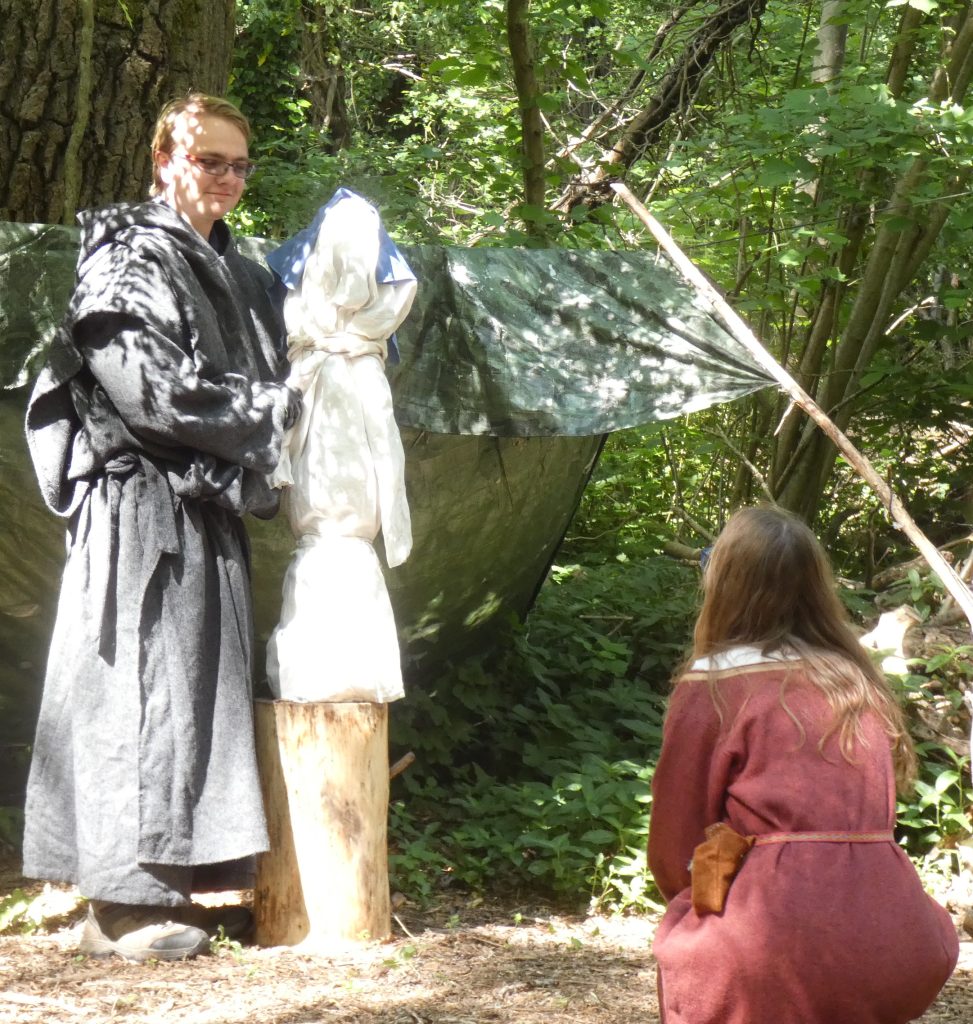
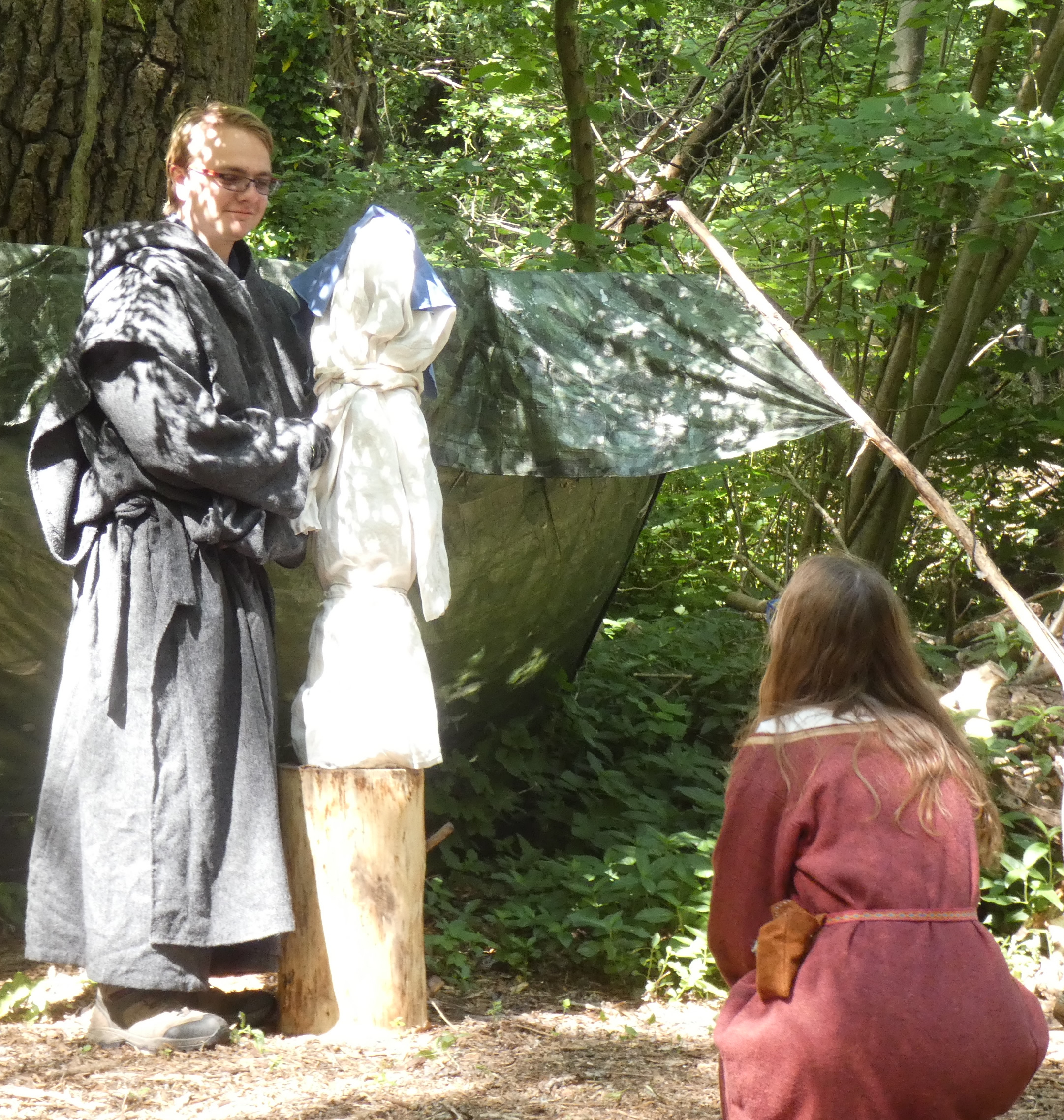
To celebrate this triumph of righteousness, I resolved that although a day was yet wanting to the feast of Saint Potentiana, we should strengthen our faith that very night by processing across the fields and through the woods while singing the beautiful hymn, the Ducks of the Lord. And in the church, by starlight I gently drew the veiling cloths from the Virgin Mary’s statue and the assembled company were struck dumb by her radiant beauty and air of calm holiness, Dane and Saxon, Christian and Pagan alike. Truly a miraculous evening.
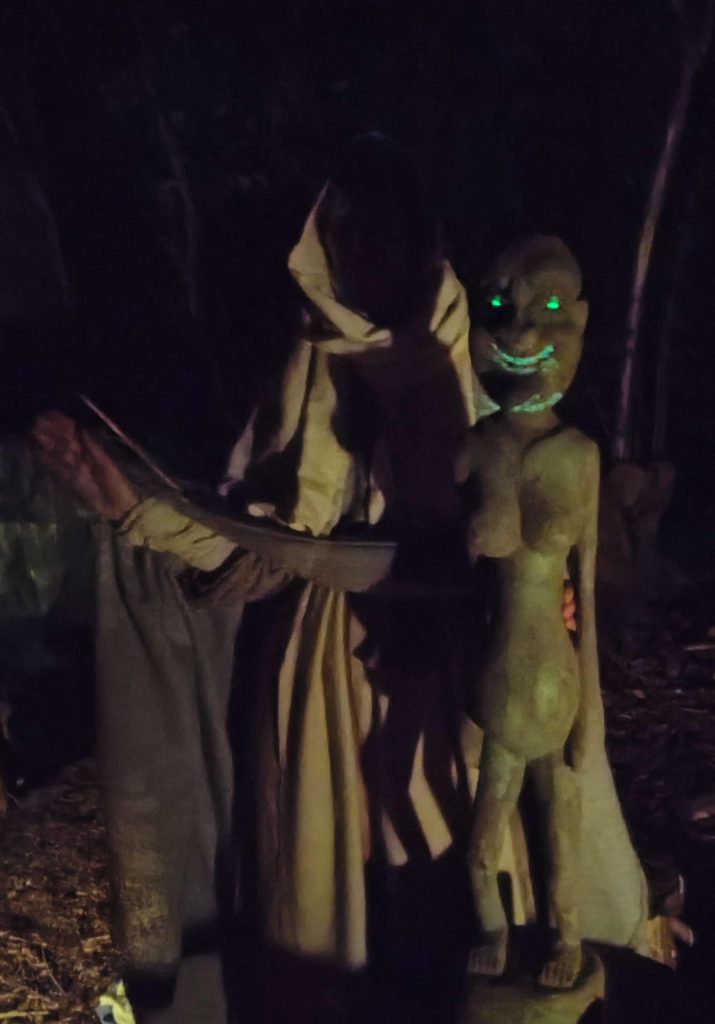
We never did find out what became of the villagers, and Loefdag seemed to have some plan of weaving cloth from caterpillar silk which I am sure he’ll never be able to persuade people is genuine silk from the far east. And I don’t know what the people of Sandford will think when they do come home from whatever journey took them away so unexpectedly, or how their kinsfold of Cytingas will say. But it matters little as the Virgin’s statue is safe, discretely garbed and veiled, in her place in the Church ready to bless and protect all Christian folk.
Continue reading →


DAS Chronicle Archive
You can read all entries in the DAS version of the Anglo-Saxon Chronicle in the archive: [intlink type=”cat” slug=”das-chronicle-archive” name=”DAS Chronicle”].